Rainwater tanks and your roof: getting the catchment ready for the first rain after the dry
Before the first big rain after this dry spell, clear the roof and gutters, fit a leaf screen or leaf-shedding rain-heads and a first-flush diverter, and if the tank is for drinking, keep lead flashing and pre-1980 paint out of the catchment or have them properly sealed. Treat an old fibro roof as asbestos, keep it out of a drinking catchment, and have it checked before anyone cleans, seals or works on it.
The first good rain after this dry spell will send the dirtiest water of the year off your roof. A first-flush diverter holds that water back, and it costs you very little of the rain. YourHome sizes a diverter at about 10 L per 50 m² of roof, and its yield rule is that 1 mm of rain on 1 m² of roof gives 1 L.
Put the two together and a diverter at that size holds back roughly the first 0.2 mm of rain, on any size of roof. The working: 10 L spread over 50 m² is 0.2 L per square metre, which is 0.2 mm. On an example 200 m² roof, that's about 40 L set aside from the roughly 2,000 L a 10 mm fall delivers, or about 2%. Those are our estimates, worked from the two YourHome figures.
So the real question isn't whether your roof can collect water. It's whether the roof, gutters and fittings send the tank water fit for what you'll use it for. Here's what each part needs to do.
Why the first rain after this dry spell is the dirtiest
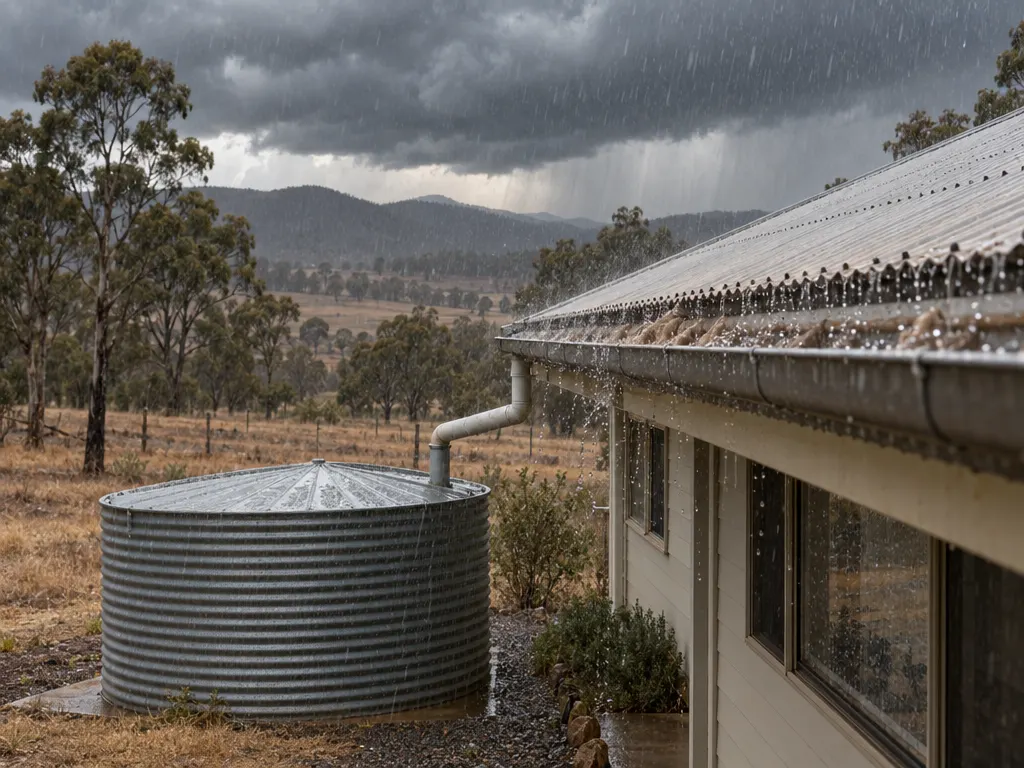
The Singleton Argus calls Singleton "the epicentre of the intense drought". It also reports that "there has been no run-off since the 2025 winter". That's a long time for dust, leaves and droppings to settle on a roof.
YourHome explains that the first rain after a dry spell washes accumulated dust and bird droppings off the roof into the tank. A first-flush diverter catches that first runoff, and the page says diverters "should be installed for all drinking water systems".
Nobody can put a date on that first rain. The Argus reports that the NSW DPIRD drought forecast to the end of December suggests the drought's intensity will ease. The Bureau's outlook issued 5 November gives a 60% to greater than 80% chance of above-average December to February rainfall across much of New South Wales, except the western-most parts. Both are forecasts. The roof work is the part you control, so do it while the weather is dry.
Is your roof fit to feed a drinking tank, or just the garden?
| Use | What YourHome asks of the roof |
|---|---|
| Garden irrigation | Any roof material except unsealed asbestos. |
| Drinking water | Avoid sections with lead flashing and roofs with pre-1980 paint, or seal them with a potable-quality roof sealant; keep an old fibro (asbestos) roof out of the catchment and have it checked before anyone works on it; no overhanging vegetation; clean roof and gutters; a good leaf screen or leaf-shedding gutter; a first-flush diverter. |
| National Construction Code Housing Provisions, clause 7.4.2: gutters, downpipes and flashings must not contain any lead on a roof forming part of a drinking-water catchment. | |
Drinking water is held to a higher standard than garden water. YourHome says rainwater can be collected from most roof types, depending on the quality needed. For garden irrigation, any roof material except unsealed asbestos will do.
For drinking water, the page says to avoid collecting from sections of roof with lead flashing or asbestos sheeting, or from roofs painted with pre-1980 paint. Where those sections can't be avoided, it says to seal them properly with a potable-quality roof sealant. It also says not to collect rainwater from the first few rainfall events after sealing, so seal well ahead of the rain or divert those falls. The building code's housing provisions go further: gutters, downpipes and flashings must not contain any lead if used on a roof forming part of a drinking-water catchment.
It's a common belief that any roof is fine for a drinking tank, but YourHome sets stricter conditions for drinking: no overhanging vegetation, a clean roof and gutters, a good leaf screen or leaf-shedding gutter, and a first-flush diverter.
If your roof is fibro, or you're not sure what it is, read our guide to fibro and asbestos roofs in the Hunter Valley before anyone works on it. NSW Health adds roofing screws with lead washers to the list, to be replaced with non-lead alternatives such as plastic washers, or painted over. Whether tank water from a particular roof is fit to drink is a question for your local public health unit.
One more point belongs here. YourHome notes that state and territory health departments recommend using the public mains supply for drinking and cooking where it is available, because it's filtered, disinfected and generally fluoridated. If your home is on mains, follow that advice for the kitchen tap.
The path from roof to tank: gutters, screens and the diverter
From roof to tank, in the order water travels
- Roof (clean, no overhanging branches, drinking-water condition)
- Eave gutter with leaf screen
- Downpipe with leaf-shedding rain-head (fit where no leaf screen; essential if the tank has no inlet strainer, as with a bladder tank)
- First-flush diverter holding the first runoff, "about 10 L per 50 m² of roof", "should be installed for all drinking water systems"
- Tank inlet with mosquito-proof mesh
- Overflow to stormwater that doesn't affect neighbours
On the NSW exempt-development route, the first-flush device needs an automatic resetting valve.
A tank only gets what the gutters pass on. YourHome's drinking conditions call for a good leaf screen or leaf-shedding gutter. Where no leaf screen is fitted, it says to fit leaf-shedding rain-heads to the downpipes. It calls them essential if the tank has no inlet strainer, as with a bladder tank.
Overhanging branches undo the rest, which is why the drinking conditions include no overhanging vegetation. Leaves in a gutter also stop it doing its basic job. The building code sizes eave gutters on the assumption that they are not blocked.
Weighing up screens? Our leaf screener page and the guide to leaf screeners in fire season explain what they do and what they don't. If the gutters themselves are sagging, rusted or holding water, our guide to gutter repair or replacement in the Hunter sets out what a proper job looks like. Fix the gutters before the tank goes on, not after.
How much tank does your household need?
Tank size in litres
- approximate, YourHome: 4 people, mains water, evenly spread rainfall; larger without mains
- NSW exempt-development cap on land not zoned RU1, RU2, RU3, RU4, RU6, R5, E2, E3 or E4 (only if all standards are met; not in a foreshore or environmentally sensitive area)
Toilet and small garden (4-person household with mains water): 2,000 to 3,000 L
Toilet, washing machine and small garden: 3,000 to 5,000 L
Whole-of-house supply: 5,000 to 20,000 L
Rain on a roof turns into litres at a simple rate: 1 mm of rain on 1 m² of roof gives 1 L. The catch in a dry district is reliability. YourHome notes that where rainfall is highly variable, much larger tanks are needed for the same supply.
For a four-person household with mains water and evenly spread rainfall, YourHome suggests about 2,000 to 3,000 L for the toilet and a small garden. Its figures rise to 3,000 to 5,000 L for the toilet, washing machine and small garden, and 5,000 to 20,000 L for whole-of-house supply. It adds that where rainfall is highly seasonal or no mains water is available, much larger tanks are typically required.
To put that against the sky: on our example 200 m² roof, filling a 5,000 L tank from empty takes 25 mm of rain. That's 5,000 L divided by 200 m², and it's our estimate. In a year with no run-off since winter, a bigger tank carries you further between falls.
On a bushfire-prone block, the material matters too: YourHome says concrete tanks have the best bushfire resistance.
Can you put a tank in without council approval in NSW?
| Where | Limit |
|---|---|
| Land not zoned RU1, RU2, RU3, RU4, RU6, R5, E2, E3 or E4 | Maximum 10,000 L |
| Land zoned RU1, RU2, RU3, RU4, RU6, R5, E2, E3 or E4 | At least 10 m from any lot boundary |
| Any zone, tank more than 1.8 m above existing ground level | At least 450 mm from the boundary |
Operating standards for an exempt tank in NSW (all must be met)
Also: behind the building line, not on existing footings, rear yard for a heritage item.
Sometimes. NSW Planning says above-ground tanks may be exempt development if they meet all the standards. It also says exempt installation isn't allowed in a foreshore or environmentally sensitive area.
Size and placement depend on zoning:
- On land not zoned RU1, RU2, RU3, RU4, RU6, R5, E2, E3 or E4, the exempt tank is limited to a maximum of 10,000 L.
- On those rural and environmental zones, the tank must be at least 10 m from any lot boundary.
- In any zone, a tank more than 1.8 m above existing ground level must be at least 450 mm from the boundary.
It must also sit behind the building line of any road frontage, not rest on the footings of an existing building, and need no more than 1 m of earth moving.
If your block is rural, measure that 10 m before you choose a spot.
To be exempt, the tank also has to meet the operating standards: a screened rain head, a first-flush device with an automatic resetting valve, mosquito-proofing, an overflow to stormwater that doesn't affect neighbours, a "rainwater" sign, and any pump in a soundproof structure. So on the exempt route, the first-flush device is part of the package whatever you use the water for. The tank also must not interconnect with a drinking-water system unless it meets the water authority's standards.
Hunter Water's area is the Lower Hunter, not Singleton, but its advice is to contact your local council before installing a tank. It's worth following here too. The council can confirm your zoning and anything else that applies to your block.
Who connects the gutters to the tank?
| Job | Who | Source |
|---|---|---|
| Connect gutters to the tank and install an overflow to stormwater | A plumber | Hunter Water guidance, Lower Hunter |
| Connect a tank to mains water | A licensed plumber | Hunter Water guidance, Lower Hunter |
| Check before installing | Your local council (Hunter Water advice) and the NSW exempt-development standards | Hunter Water; NSW Planning |
| NSW roof plumbing (guttering, downpipes, roof flashing, roof coverings; not work on non-metallic tile, slate, glass, concrete, timber or malthoid roof coverings) | Licence or certificate, and a contractor licence for work over $5,000 in labour and materials (checked November 2026) | NSW Government, roof plumbing work |
A plumber. Hunter Water says a plumber is also required to connect your gutters to your tank and install an overflow to the stormwater system, and that a licensed plumber is required to connect a tank to mains water. Hunter Water serves the Lower Hunter, so treat that as regional guidance rather than Singleton Council's own rule.
NSW licensing splits the job in two. NSW roof plumbing includes fixing, installing, repairing and maintaining guttering, downpipes, roof flashing and roof coverings, and it needs a licence or certificate. Connecting a tank into the house's water supply is water plumbing, which needs a licensed plumber. The same page says roof plumbing does not include work on non-metallic tile, slate, glass, concrete, timber or malthoid roof coverings.
Residential building or trade work, including roof plumbing, valued at more than $5,000 in labour and materials, including GST, needs a contractor licence (checked November 2026). Penalties for unlicensed work are $22,000 for an individual and $110,000 for a company (checked November 2026).
Our advice at Singleton Roofing is to get the order right. Sort the roof and gutters first, so the plumber is connecting the tank to a clean, sound catchment.
Keeping the catchment clean once the tank is on
Keeping the catchment clean
Often
Clear roof and gutter debris, check gutters and pipes for leaks
After 12 months
Flush downpipes
Every two to three years
Have sediment removed
All along: gutter guards or downpipe screens, and mosquito-proof mesh
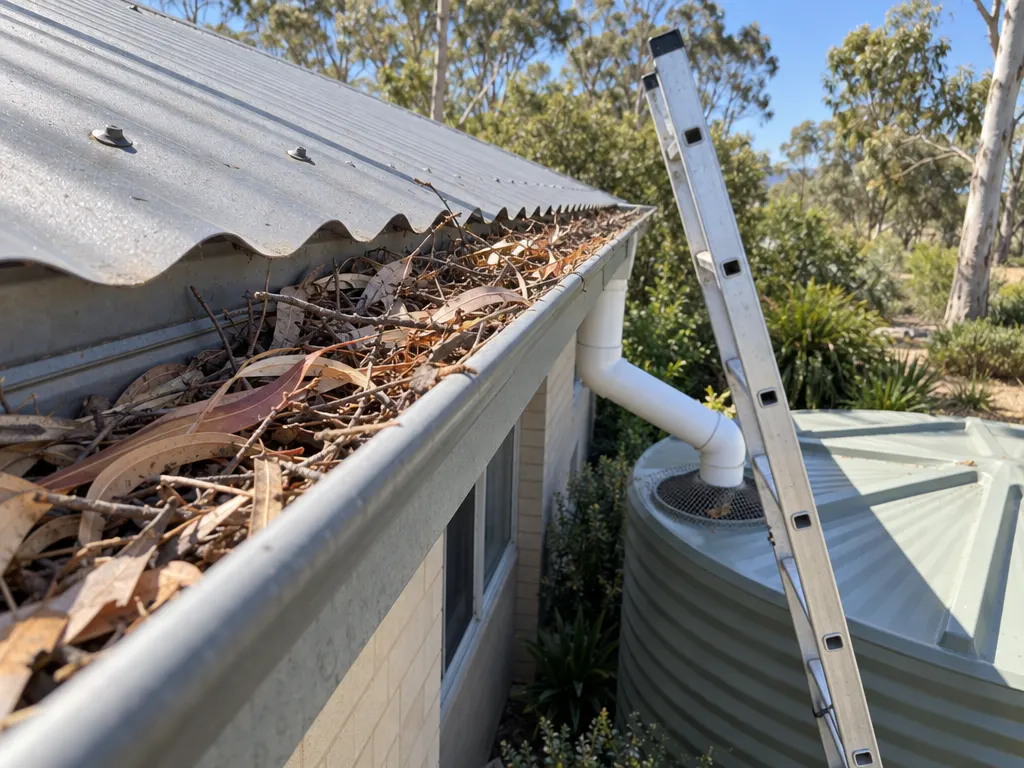
A tank is only as clean as the roof feeding it, every time it rains. Hunter Water's maintenance list is short:
- Check for leaks in gutters and pipes, flush downpipes after 12 months, and have sediment removed every two to three years.
- Fit gutter guards or downpipe screens and mosquito-proof mesh.
- Clear roof and gutter debris often.
Do the clear-out on a dry, calm day before rain is forecast. A wet roof is no place to be, and the first flush starts with the first drops.
The figures to keep
The figures to keep
First-flush diverter sizing:
about 10 L per 50 m² of roof
Source: YourHome
Rainfall yield:
1 mm of rain on 1 m² of roof = 1 L
Source: YourHome
Exempt tank cap, non-rural zones:
10,000 L
NSW exempt development only, all standards met, not in a foreshore or environmentally sensitive area
Source: NSW Planning
Exempt tank setback, rural zones:
at least 10 m from any lot boundary
RU1, RU2, RU3, RU4, RU6, R5, E2, E3, E4
Source: NSW Planning
Roof plumbing contractor licence threshold:
$5,000 labour and materials (checked November 2026)
Source: NSW Government
Here are the checked numbers in one place, from the diverter to the licence threshold, so you can work out your own roof before you talk to anyone about it.
Get the roof side ready with Singleton Roofing
If a tank is part of your plan for this summer, start with what it drinks from. Ask Singleton Roofing for a roofing quote through our contact page. Tell us a tank is going in and what the water is for. Mention anything you already know about the roof, such as fibro sheeting, old paint or lead flashing.
For general roof work, our roof repairs and roofing services page has more. The gutter-to-tank connection is licensed roof plumbing and the house connection is a licensed plumber's job, so check the licence for each part and line them up for after the roof and gutters are done.
Sources
- https://www.singletonargus.com.au/story/9379127/hunter-valley-drought-deepens-as-singleton-hits-crisis-point
- https://www.yourhome.gov.au/water/rainwater
- https://www.bom.gov.au/climate/ahead/outlooks/
- https://ncc.abcb.gov.au/editions/ncc-2022/adopted/housing-provisions/7-roof-and-wall-cladding/part-74-gutters-and-downpipes
- https://www.planning.nsw.gov.au/the-planning-system/development-assessment/planning-approval-pathways/development-types/rainwater-tanks
- https://www.hunterwater.com.au/water-and-environment/saving-water/water-saving-tips/rainwater-tanks
- https://www.nsw.gov.au/business-and-economy/licences-and-credentials/building-and-trade-licences-and-registrations/roof-plumbing-work
- https://www.nsw.gov.au/business-and-economy/licences-and-credentials/building-and-trade-licences-and-registrations/plumbing-draining-and-gasfitting
- https://www.health.nsw.gov.au/environment/water/Pages/rainwater.aspx