Gutter repair or replacement in the Hunter: what a proper job looks like and who can do it
A gutter job done properly gets the fall, brackets, downpipes and overflow right for your roof, uses gutters that suit the roofing above them, and is done under a written contract where the job needs one, by someone whose licence you have checked before you sign.
New gutters are judged on the day they block. Under the National Construction Code 2022 Housing Provisions, which NSW follows until it adopts NCC 2025 on 1 May 2027, eave gutters are sized for a 5-minute rainfall intensity at 5% annual exceedance probability, provided they are not blocked. The overflow has a harder job. It has to cope with the 1% event and keep water from ponding against, entering or damaging the house.
At Newcastle, the nearest listed locality to Singleton, those two figures are 225 mm an hour and 316 mm an hour. That means the overflow is planned for rain about 40% heavier than the gutter itself is sized to carry. That is our estimate: 316 ÷ 225 is about 1.40.
So the short answer to "repair or replace, and what should I check?" is this. A proper job gets the fall, the brackets, the downpipes and the overflow right. It uses gutters that suit your roof. And it is done under a written contract where the job needs one, by someone whose licence you have checked. The rest of this guide explains each of those on a Hunter home.
How hard does rain fall on a Hunter gutter?
5-minute design rainfall intensity, mm/h
- Gutter sized for (5% AEP, gutter not blocked)
- Overflow must cope with (1% AEP)
Newcastle (nearest listed locality to Singleton)
Sydney
Singleton isn't in the Housing Provisions' rainfall table, so Newcastle is the nearest listed locality. Its 5-minute design intensities are 225 mm/h at 5% and 316 mm/h at 1%. Sydney's are 201 mm/h and 262 mm/h.
By our estimate, Newcastle's gutter-sizing figure sits about 12% above Sydney's (225 ÷ 201). Its overflow figure sits about 21% above (316 ÷ 262).
The five minutes matter. Gutters rarely fail in a day of steady drizzle. They fail in the short, hard burst of a summer storm.
A 5% annual exceedance probability means a burst that heavy has roughly a one-in-20 chance of happening in any given year. At 1%, the chance is one in 100. A gutter quote written for the Hunter should be built around bursts like these.
Gutter repair or gutter replacement?
Check from the ground, no ladder.
Installed less than 6 years ago: ask the installer to inspect and fix it. Older than 6 years: get a report from a builder or building consultant.
Start on the ground, not on a ladder. NSW's building guidance lists the signs of a guttering problem. Look for watermarking, stains or damp patches on the eaves or outside walls, or on the inside of the walls around the edge of the house.
A blocked gutter is more than a cleaning job: blockages can trap water and make it overflow under the eaves into the roof cavity.
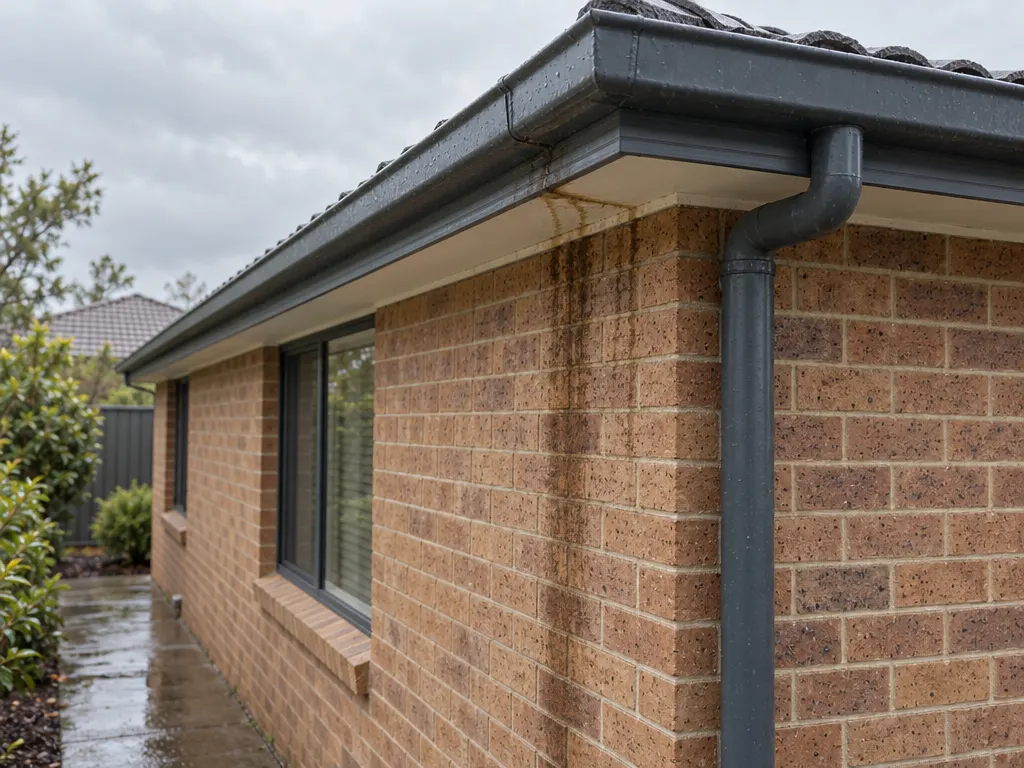
As a rule of thumb, small faults are usually repairs. A single leaking joint, a loose bracket or a downpipe that has dropped off its outlet can be fixed on its own.
Some runs are better replaced. Think of a run that has rusted through in several places, has lost its fall along much of its length, or can't take a proper overflow detail.
Age changes who you call. If the guttering was installed less than 6 years ago, ask the installer to inspect and fix it. If it is older than 6 years, NSW suggests hiring a builder or building consultant for a report.
What should new gutters have?
One eave gutter run, working and blocked
Working: rain off the roof sheets runs along the fall to the downpipe.
- Fall at least 1:500
- Brackets at each stop end and corner, and at no more than 1.2 m centres
- One downpipe for no more than 12 m of gutter
- Downpipe as close as possible to a valley gutter
Blocked: leaves at the outlet, water leaves through slots in the gutter front and falls clear of the wall.
- Overflow: must cope with the 1% event even when blocked (not required for verandah eave gutters, or eaves wider than 450 mm that are unlined or raked)
These are the points worth seeing in writing on any quote for new eave gutters.
- Fall. Eave gutters must have a fall of not less than 1:500. By our estimate, 1:500 works out to 2 mm per metre, or 24 mm over a 12 m run.
- Brackets. They must be securely fixed at stop ends, corners and at no more than 1.2 m centres.
- Downpipes. One downpipe must serve no more than a 12 m length of gutter, and downpipes should sit as close as possible to valley gutters. By our estimate, a 30 m run of eave gutter needs at least three downpipes: 30 ÷ 12 is 2.5, rounded up.
- Downpipe type. The Housing Provisions allow 75 mm round, 90 mm round, 100 x 50 mm and 100 x 75 mm downpipes. The 75 mm round is not suitable with the 150 mm D gutter.
- Materials. Gutters, downpipes and flashings must be compatible with the upstream roofing materials. If you drink from a rainwater tank, note that no lead is allowed on a roof that forms part of a drinking-water catchment.
| Type | Profile | Minimum cross-section |
|---|---|---|
| A | rectangular | 6,500 mm² |
| B | large rectangular | 7,900 mm² |
| C | 115 mm D | 5,200 mm² |
| D | 125 mm D | 6,300 mm² |
| E | 150 mm D | 9,000 mm² |
| 75 mm round (not suitable with the 150 mm D gutter) |
| 90 mm round |
| 100 x 50 mm |
| 100 x 75 mm |
The gutter profile is one input among several. The minimum cross-sections range from 5,200 mm² for a 115 mm D gutter to 9,000 mm² for a 150 mm D. The right choice for your house still depends on the roof area, the roof slope and the rainfall. A good installer can show you that working. These are the figures the Australian Building Codes Board publishes for the Housing Provisions, so ask your installer which edition applies to your job.
Two parts of a roof sit outside the simple rules.
- Box gutters are no longer covered by the Housing Provisions' deemed-to-satisfy rules. They must be designed to AS/NZS 3500.3 or as a Performance Solution.
- Valley gutters need a roof pitch above 12.5 degrees, a side angle of at least 12.5 degrees and at least 15 mm freeboard.
If your roof has either, expect the quote to say so.
Colorbond steel gutters, fascia and downpipes come in 22 colours. BlueScope says to look for the Colorbond branding to confirm the product is genuine. Cutting debris, called swarf, can leave rust spots, and preventing swarf rust-spotting is the installer's job. Our Colorbond roofing page covers matching gutters to a steel roof.
How should a gutter overflow when it blocks?
Examples of overflow measures
(1) Front-face slots. At least 1200 mm² per metre, lower edge 25 mm below the top of the fascia. 0.5 L/s per metre.
(2) Controlled back gap. 10 mm or more. 1.5 L/s per metre.
(3) Rainhead. 75 mm hole. 3.5 L/s.
Overflow measures are not required for an eave gutter on a verandah, or on an eave wider than 450 mm that is unlined or raked.
Overflow measures have to cope with the 1% event and direct water away so it does not pond against, enter or damage the building, even if the system is blocked. The NCC Navigator gives examples of overflow measures, including:
- Front-face slots. At least 1200 mm² of slots per metre, with the lower edge 25 mm below the top of the fascia. They handle 0.5 L/s per metre.
- A controlled back gap. A gap of 10 mm or more handles 1.5 L/s per metre.
- A rainhead. One with a 75 mm hole handles 3.5 L/s.
By our estimate, along a 12 m run that is about 6 L/s through slots, or about 18 L/s through a back gap. A rainhead's 3.5 L/s works at a single outlet.
There is a scope limit. Overflow measures are not required for an eave gutter on a verandah, or on an eave wider than 450 mm that is unlined or raked. Everywhere else, ask any installer which method they will use and where it goes. A quote that doesn't mention overflow leaves out the part of the job that matters most when the gutter is full of leaves.
Who can install gutters in NSW?
| Counts as roof plumbing in NSW | Not roof plumbing |
|---|---|
| Fixing, installing, renovating, altering, repairing and maintaining guttering, downpipes, roof flashing and roof coverings. | Work on non-metallic tile, slate, glass, concrete, timber or malthoid roof coverings. |
| Contractor licence needed: roof plumbing work valued above $5,000 in labour and materials, including GST. | |
In NSW, roof plumbing includes fixing, installing, renovating, altering, repairing and maintaining guttering, downpipes, roof flashing and roof coverings. Roof plumbing work valued above $5,000 in labour and materials, including GST, needs a contractor licence. The fines for unlicensed work are $22,000 for an individual and $110,000 for a company (checked October 2026).
The same page says roof plumbing does not include work on non-metallic tile, slate, glass, concrete, timber or malthoid roof coverings. That carve-out is about the roof covering. It doesn't settle the gutters on a tiled house, so ask the tradesperson what licence covers that work.
Building Commission NSW is plain about guttering: builders, plumbers and roof plumbers installing guttering must be licensed, and you should check licence details before signing.
Watch the name on the paperwork. A licence in an individual's name does not let their company make the contract. If a company is contracting, the company needs its own licence.
What to check before you sign
Job value, including GST
Over $5,000: written contract required.
$5,000 to $20,000: small-job contract.
Over $20,000: large-job contract, cooling-off period of five clear business days, home building compensation cover.
Company contracting? The company needs its own licence.
Deposit: no more than 10% of the contract price.
The paperwork rules step up with the size of the job.
- Over $5,000. A written contract is required for work over $5,000, including GST.
- $5,000 to $20,000. These jobs need a small-job contract.
- Over $20,000. These jobs need a large-job contract with a cooling-off period of five clear business days, and home building compensation cover applies.
- Deposit. The maximum deposit is 10% of the contract price.
Beyond the contract, a good gutter quote answers these questions in writing:
- Whose licence is it, and does it match the name on the contract?
- How many downpipes are there, and where do they go?
- Which overflow method will be used, or why none is needed?
- What gutter and downpipe material is being used, and does it suit your roofing?
- Is the job a repair of named sections, or a full replacement?
What if new gutters leak or stain?
From the day the work is completed
Work completed
2 years: statutory warranty for all other defects ends
6 years: statutory warranty for major defects ends
Ask the installer to inspect and fix it
Hire a builder or building consultant for a report
Home building work in NSW carries statutory warranties of 6 years for major defects and 2 years for all other defects, from completion.
If stains or damp patches turn up and the gutters went in less than 6 years ago, ask the installer to inspect and fix it. Keep your contract, invoice and photos of the marks. They are what that conversation runs on.
Older Hunter homes, leaves and storms
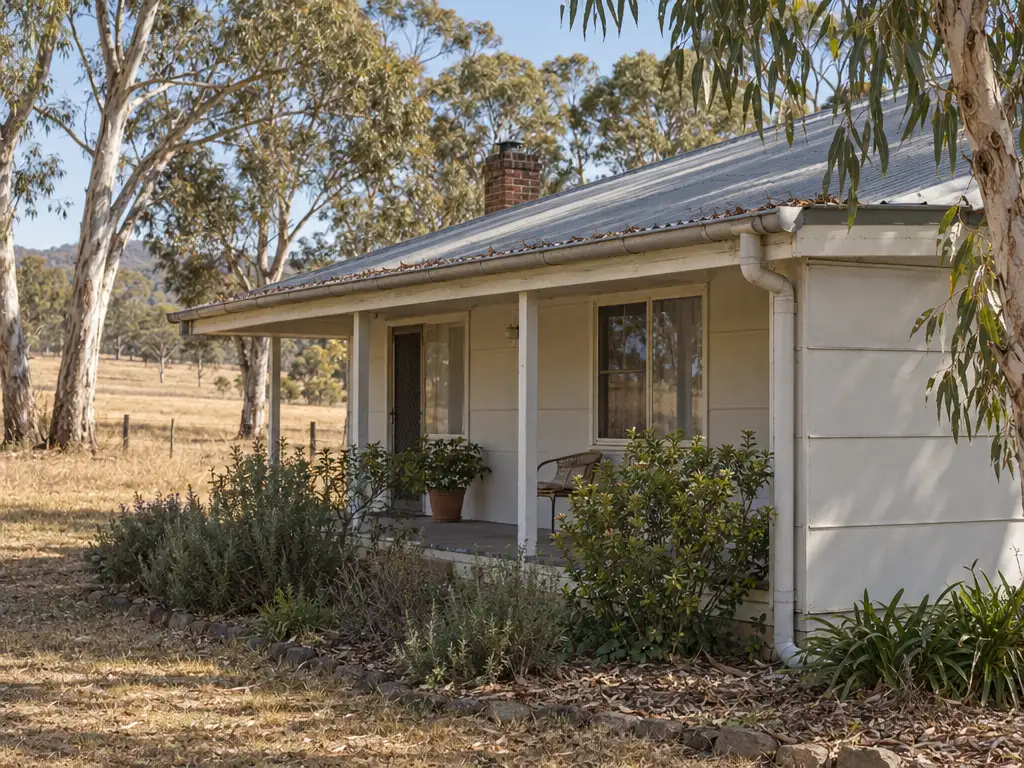
Asbestos is found in many homes built before 1990, including roofing, eaves and fencing. Don't use high-pressure water, brooms, compressed air or power tools on anything that might contain it. Our guide to fibro and asbestos roofs explains what to do first.
Leaves are the other half of the story. The RFS suggests cleaning gutters of leaves and twigs and installing metal gutter guards. Our leaf screeners in fire season guide covers what guards do and don't do.
After a big storm, start with our roof inspection after a storm guide. For a seasonal once-over, see the spring storm and fire season roof and gutter check.
The gutter job at a glance
On the roof
- Fall at least 1:500
- Brackets at stop ends, corners and no more than 1.2 m centres
- One downpipe for no more than 12 m of gutter
- Overflow that copes with the 1% event (not required for verandah eave gutters, or eaves wider than 450 mm that are unlined or raked)
- Gutters compatible with the roofing above
On paper
- Contractor licence for roof plumbing work above $5,000 including GST
- Company contracting needs its own licence
- Written contract over $5,000 including GST
- Deposit no more than 10%
- Statutory warranties of 2 years (all defects) and 6 years (major defects) from completion
Two lists matter. On the roof: the fall, the brackets, the downpipes, the overflow and a material that suits the roofing. On paper: the licence, the contract, the deposit and the warranty. A quote that covers both lists is one you can compare fairly against another.
Get your gutters looked at
If you have stains on the eaves, a sagging run or a quote you'd like a second opinion on, talk to Singleton Roofing. Ask us the same questions this guide gives you to ask anyone: the licence, the contract, the downpipes and how the gutters will overflow. You can request a roofing quote from Singleton Roofing and tell us what you're seeing from the ground.
Sources
- https://ncc.abcb.gov.au/editions/ncc-2022/adopted/housing-provisions/7-roof-and-wall-cladding/part-74-gutters-and-downpipes
- https://ncc.abcb.gov.au/ncc-navigator/gutter-and-downpipe-provisions-housing
- https://ncc.abcb.gov.au/ncc-2025/ncc-2025-state-and-territory-adoption-information
- https://www.ses.nsw.gov.au/plan-and-prepare/prepare-your-home
- https://www.nsw.gov.au/business-and-economy/licences-and-credentials/building-and-trade-licences-and-registrations/roof-plumbing-work
- https://www.nsw.gov.au/housing-and-construction/building-or-renovating-a-home/during-building-process/installing-high-front-gutters
- https://www.nsw.gov.au/housing-and-construction/building-or-renovating-a-home/preparing/contracts
- https://colorbond.com/products/guttering-and-fascia
- https://www.rfs.nsw.gov.au/plan-and-prepare/prepare-your-property
- https://www.asbestos.nsw.gov.au/safety/managing-asbestos-in-emergencies-and-disasters