Roof inspection after a storm: what to check, who to call and who to hire
After a storm, check the roof from the ground and from inside rather than climbing up, call 000 if anyone is hurt and NSW SES on 132 500 if the roof is damaged or leaking, check with your insurer before any repair beyond stopping further damage, and remember that residential work over $5,000 (checked October 2026) needs a licensed builder even in an emergency.
The weather has cleared and you want to know if the roof made it through. The short answer is to look from the ground and from inside, not from up a ladder, and to make your calls in the right order.
That order is the part people get wrong, and no single official page lays it out. Put the NSW SES and NSW Government pages side by side and it runs like this:
- SES first, for a stopgap. SES volunteers do temporary emergency measures only. Permanent repairs are left to your insurer or a private contractor.
- Your insurer next. Call them as soon as possible and before repairs. They tell you what you're covered for and send an assessor.
- The roofer last. Residential building work valued over $5,000, labour plus materials, needs a licence (checked October 2026).
So the SES tarp is not the repair. And the stranger who knocks the morning after is your last call, not your first.
If you worked through our spring storm and fire danger roof check before the season, this is the other half. Here is how Singleton Roofing would walk you through the days after a storm.
Roof inspection after a storm: who to call, and in what order
- Step 1
Anyone trapped or injured: call 000. Life-threatening emergencies always come first.
- Step 2
Roof damaged or leaking, or damage you can't fix yourself: NSW SES 132 500. Note your reference number. SES does temporary emergency measures only.
- Step 3
No longer need SES? Call 132 500 with your reference number to cancel.
- Step 4
Insurer, as soon as possible: check before making or arranging any repairs. Photograph the damage and take reasonable steps to prevent further damage.
- Step 5
Roofer for permanent repairs: residential building work over $5,000 labour and materials needs a licence (checked October 2026). No exemption for emergency work.
If anyone is trapped or injured, call 000. SES handles requests in priority order, and a life-threatening emergency always comes first.
If the roof is damaged or leaking, or the damage is beyond what you can fix yourself, call NSW SES on 132 500. The call is logged and you get a reference number. Write it down with the date.
If you sort it out another way before a crew arrives, call 132 500 quoting your reference number to cancel. That frees the crew for the next house.
If none of SES's questions apply to you, SES says to contact your insurer or a private contractor, or to repair it yourself "if safe to do so". On a roof, that "if" is doing a lot of work.
Is it safe to look at the roof yet?
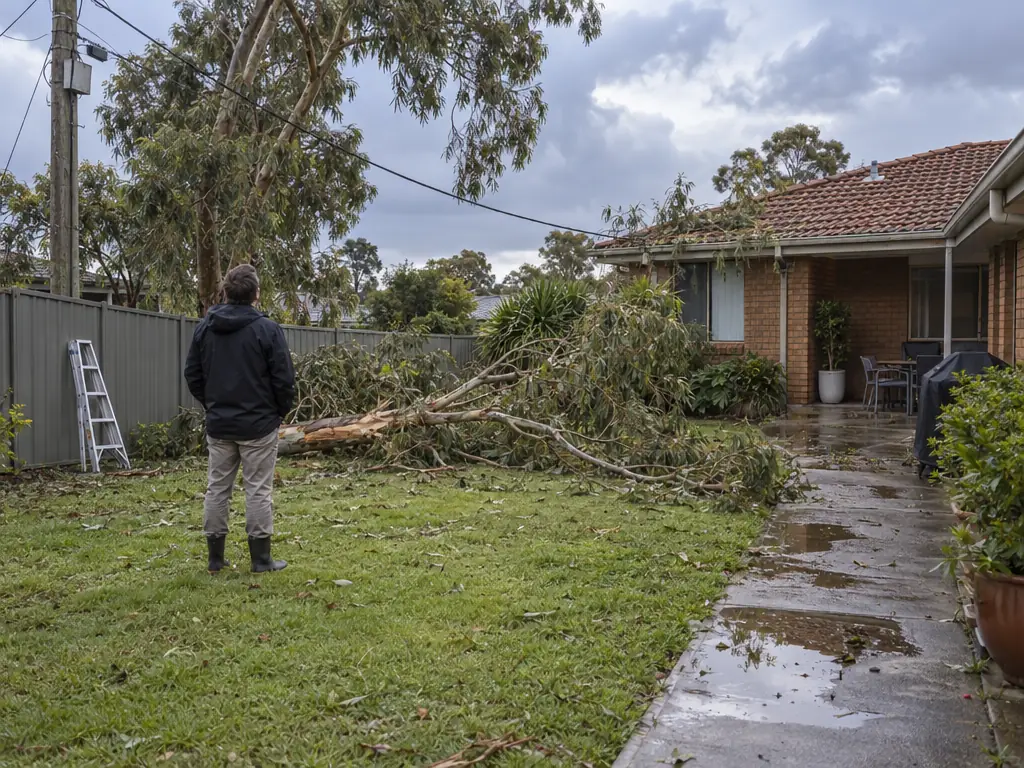
Start with the hazards on the ground. SES advises you to check the roof's structural stability before entering, along with windows and walls. It also warns that branches may have loosened and can fall without warning, and to stay away from fallen powerlines.
Then stay on the ground. SafeWork NSW puts it plainly: "If you don't have to work at heights, don't." A roof just after rain is wet, and wet tiles and sheet metal give poor grip. Falls also happen through fragile roofing such as skylights and plastic sheeting, which can be hard to spot after a storm.
Sometimes a ladder is unavoidable, for example to look into a gutter. If so, follow SafeWork's ladder tips:
- Don't stand on the top two steps.
- Don't overreach.
- Keep all four feet on the ground.
- Secure an extension ladder top and bottom, and have it extend 1 m past the landing.
A roof inspection from the ground: what to look for
Walk around the house, then check inside
From the yard
- Ridge capping.
- Roof face: loose tiles, loose metal sheets and screws, and built-up dirt that can block drainage channels.Source: NSW SES
- Flashings at the chimney, vent and skylight.
- Gutters and downpipes, pulled away or blocked.Source: NSW SES
- The underside of the eaves, for drips or stains.
- The ground, for fallen pieces.
Inside
- Ceilings and cornices.
- The roof cavity, seen from the manhole.
SES's own roof list is short: leaks, loose tiles, loose metal sheets and screws. You can check most of it from the yard with a phone camera on zoom or a pair of binoculars. Walk around the house in this order and photograph anything that looks different from before:
- The ridge line. Look for cracked or missing ridge capping on a tile roof, or bent capping on a metal roof.
- The roof face. Look for slipped, cracked or missing tiles, sheets lifted at the edges, and screws standing proud.
- Flashings. Check the metal strips around chimneys, vents, skylights and where the roof meets a wall.
- Gutters and downpipes. Look for gutters pulled away or sagging, gutters packed with leaves, and downpipes knocked loose.
- Under the eaves. Look for drips, stains or swollen lining boards.
- The ground. Look for pieces of tile, sheet or capping in the garden.
Leaves and grit left on the roof matter too. SES says built-up dirt on the roof should be removed because it can block drainage channels. Getting it off is a job for someone set up to work at height. The same goes for anything you spot on a tile roof or a metal roof.
Why a blocked gutter can put water in your ceiling
A ceiling stain doesn't always mean a hole in the roof. SES notes that blocked gutters, downpipes and drains can trap water and make it overflow under the eaves into the roof cavity.
In practice, a gutter full of storm leaves can send water backwards, over its inner edge and into the roof space. The roof sheets or tiles above can be perfectly sound.
That is why point 4 on the walk-around matters as much as the roof itself. If your gutters fill every time the wind blows, our page on leaf screeners for gutters covers one way to cut the load.
What to check from inside the house
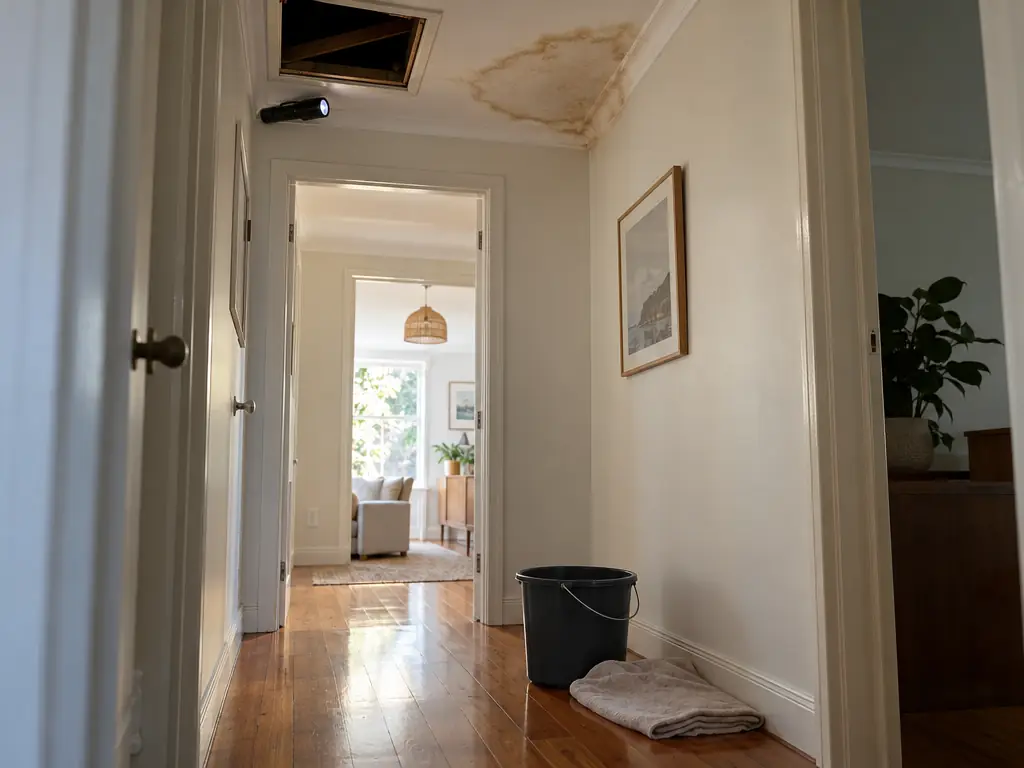
Inside, you are looking for water that got past the roof:
- brown rings or sagging patches on the ceiling
- damp cornices
- peeling paint near the top of walls
If a stain sits near a light fitting, leave the fitting alone and get an electrician to check it.
If your manhole is easy to reach, look into the roof cavity with a torch from the top of a stable stepladder. Look for damp insulation, wet timber and daylight showing through. Don't climb in if you are unsure the structure is sound, and never step between the joists.
Record as you go. The NSW Government says to take photos or videos and list all damage in detail, and to keep damaged items unless they are a hazard. Note the date beside each photo and keep your SES reference number with them.
Fibro or an older roof? Look, but don't touch
| If you're about to... | What NSW guidance says |
|---|---|
| Work out whether it's asbestos | Only a licensed asbestos assessor or occupational hygienist can correctly identify it; treat all fibro with caution. |
| Walk on a corrugated fibro roof | Don't: corrugated asbestos roofs are brittle and slippery when wet. |
| Clean up broken pieces | No high-pressure water, brooms, compressed air or power tools on asbestos-containing material. |
| Throw pieces out | Not in bins or kerbside collection. |
| Decide what to do with it | Safest to leave it where it is, or keep it contained, until a professional can help. |
| Remove it | Less than 10 m² of non-friable asbestos doesn't need a licensed removalist but still needs a P2 mask and protective gear; friable asbestos, or 10 m² or more, needs a licensed removalist. |
Asbestos is found in many homes built before 1990, including roofing, eaves and fencing. Storms can damage it, move it, or make it friable, which means crumbly enough to release fibres.
You can't tell by looking. Only a licensed asbestos assessor or occupational hygienist can correctly identify asbestos, so treat all fibro with caution.
After a storm, that caution means a few firm rules:
- Don't walk on corrugated asbestos roofs. They are brittle and slippery when wet.
- Don't use high-pressure water, brooms, compressed air or power tools on broken pieces.
- Don't put pieces in bins or kerbside collection.
The NSW asbestos site says it is safest to leave asbestos where it is, or keep it contained, until a professional can help. Licensed removalists may not be free straight away after a big storm.
If removal does come up, SafeWork NSW sets two thresholds. Less than 10 m² of non-friable asbestos doesn't need a licensed removalist, but it still needs a P2 mask and protective gear. Friable asbestos, or 10 m² or more, needs a licensed removalist.
For the longer story on fibro roofs, read our fibro and asbestos roofs guide and the fibro roofs page.
What to tell your insurer before any repair
A storm claim, step by step
- 1
Contact your insurer as soon as possible: cover, claims process, excess.
- 2
Photos or videos, a detailed damage list, keep damaged items unless they're a hazard.
- 3
Assessor inspects.
- 4
Decision usually within 4 months (up to 12 months if an extraordinary catastrophe is declared).
Unhappy? Complain to the insurer first (decisions usually within 30 days), then AFCA.
Cash settlement: damage found afterwards is not covered; you organise repairs.
The NSW Government says to check with your insurer before making or arranging any repairs, because your policy may not cover unauthorised repairs.
That doesn't mean leaving the hall flooding. The same page says to photograph the damage and take reasonable steps to prevent further damage. A bucket, a moved bookcase or an SES tarp all fit that description.
When you call, your insurer tells you what you're covered for, the claims process and any excess, and an assessor then inspects. Under the General Insurance Code of Practice, you should usually get a decision within 4 months. That stretches to up to 12 months if an extraordinary catastrophe is declared.
Three more points are worth knowing before you sign anything:
- Cash settlements. If you take one, any damage found afterwards is not covered and you organise the repairs yourself. A thorough roof inspection before you accept makes sense.
- No flood cover. If your policy lacks flood cover, you may still be covered for storm or rainwater damage, but you must prove the cause. Your dated photos help here.
- Complaints. These go to the insurer first, with decisions usually within 30 days, and then to AFCA.
Whether a given roof is covered is a question only your insurer can answer, so ask them directly.
How to hire a licensed roofer, not whoever knocks
Contract value, labour plus materials
Deposit: no more than 10% of the contract price.
Over $5,000: licence required, no exemption for emergency work. Written contract required, except emergency work that must start immediately; once the emergency passes and work continues, the contractor should arrange one.
Over $20,000: home building compensation cover applies to contracted work.
An emergency does not switch off the licensing rules: NSW says "There are no exemptions from the licensing provisions in regard to emergency work."
The same NSW Government page sets the rest of the rules:
- Licence. Residential building work valued over $5,000 (checked October 2026), labour plus materials, needs a licence.
- Written contract. One is required over $5,000 (checked October 2026). The exception is emergency work that must start immediately. Once the emergency passes and work over $5,000 continues, the contractor should arrange a written contract.
- Home building compensation cover. This applies to contracted work over $20,000 (checked October 2026).
- Deposit. It can't exceed 10% of the contract price.
Our working on that last rule: 10% of the contract price is the cap, so a request for half up front is well past it.
Five checks before you hire
Service NSW's guide to protecting yourself from fraudsters after a natural disaster adds five checks before you hire:
- Check their licence.
- Ask for references and previous work.
- Check what the contract includes.
- Confirm any subcontractors.
- Check for insurance beyond mandatory home building compensation cover.
Put every one of those questions to any roofer you talk to, Singleton Roofing included.
Is a roof inspection worth it when nothing looks wrong?
Some of what SES lists doesn't show from the lawn. Loose screws, dirt building up in drainage channels and a gutter starting to back up are all on SES's roof list. None of them announces itself until the next heavy rain.
A look by someone equipped to work at height is how you find those small things while they are still small. No one can promise what an inspection will turn up. It simply replaces a guess with a look.
After a storm: the numbers at a glance
000: anyone trapped or injured.
Source: ses.nsw.gov.au
132 500: NSW SES, roof damaged or leaking.
Source: ses.nsw.gov.au
Insurer decision: usually within 4 months, up to 12 if an extraordinary catastrophe is declared.
Source: nsw.gov.au
Licence: residential work over $5,000 labour and materials, no emergency exemption (checked October 2026).
Source: nsw.gov.au
Written contract: over $5,000, except emergency work that must start immediately (checked October 2026).
Source: nsw.gov.au
Home building compensation cover: contracted work over $20,000 (checked October 2026). Deposit: no more than 10%.
Source: nsw.gov.au
Asbestos removal: under 10 m² non-friable without a licensed removalist but with P2 mask and gear; friable or 10 m² or more needs a licensed removalist.
Source: safework.nsw.gov.au
These are the figures from this guide, gathered in one place. Each one keeps the conditions the sections above give it.
- 000: anyone trapped or injured.
- 132 500: NSW SES, for a roof that is damaged or leaking.
- Insurer decision: usually within 4 months, or up to 12 if an extraordinary catastrophe is declared.
- Licence: for residential work over $5,000 (checked October 2026), with no emergency exemption.
- Written contract: for work over $5,000 (checked October 2026), except emergency work that must start immediately.
- Home building compensation cover: for contracted work over $20,000 (checked October 2026).
- Deposit: no more than 10% of the contract price.
- Asbestos removal: under 10 m² of non-friable asbestos doesn't need a licensed removalist but still needs a P2 mask and protective gear. Friable asbestos, or 10 m² or more, needs a licensed removalist.
Book a post-storm roof inspection with Singleton Roofing
Once the weather has cleared, the SES call is made if you needed it, and your insurer knows what happened, the next step is a proper look at the roof.
Send Singleton Roofing your dated photos and a short note of what you saw from the ground and inside through our contact page. Ask about a roof inspection. If repairs follow, our roof repairs and roofing services page explains the work we do.
Sources
- https://www.ses.nsw.gov.au/contact-nsw-ses
- https://www.ses.nsw.gov.au/recovery
- https://www.ses.nsw.gov.au/plan-and-prepare/prepare-your-home
- https://www.safework.nsw.gov.au/hazards-a-z/working-at-heights
- https://www.asbestos.nsw.gov.au/safety/managing-asbestos-in-emergencies-and-disasters
- https://www.safework.nsw.gov.au/resource-library/natural-disasters/property-hazards-after-storms-and-floods
- https://www.nsw.gov.au/emergency/recovery/legal-and-insurance
- https://www.nsw.gov.au/housing-and-construction/building-or-renovating-a-home/during-building-process/emergency-repairs
- https://www.service.nsw.gov.au/referral/protect-yourself-from-fraudsters-after-a-natural-disaster