Roof work on a Total Fire Ban day: what the NSW rules mean for Hunter homes
On a Total Fire Ban day in NSW, spark or flame work such as grinding, welding or gas cutting is not to be done in the open unless an exemption covers it, and the standard exemptions count only when that day's ban order names them, so if your roof job needs that kind of work, settle the plan with your roofer when you book and check the RFS the afternoon before.
If a Total Fire Ban is declared for the day your roof job needs spark or flame work outdoors, no paperwork can be sorted out on short notice. The NSW Rural Fire Service determines ratings and bans each afternoon for the following day. A specific exemption from a ban needs a minimum of 21 days' processing. Put those side by side and the gap is plain, on our working: a ban gives you less than a day's notice, and the exemption route needs at least 21 days. So the time to settle what happens on a ban day is when you book the job, not the afternoon before.
This guide from Singleton Roofing sets out what the NSW rules say, what they mean for work on a roof, and how to check. Singleton is in the RFS Greater Hunter area, which includes Singleton, and the statutory Bush Fire Danger Period runs 1 October to 31 March, though it may vary locally.
What a Total Fire Ban is, and how much notice you get
A fire danger rating tells you how bad conditions are. On the RFS scale, High means "Be ready to act", Extreme means "Take action now to protect your life and property", and Catastrophic means "For your survival, leave bush fire risk areas". A Total Fire Ban is the step that brings in rules about fire and sparks in the open.
A ban is not reserved for Extreme or Catastrophic days. The RFS says the hot, dry, windy days when fires spread are usually rated Extreme or Catastrophic, and that the Commissioner may declare a ban to cut the risk, yet Greater Hunter had one on 12 October 2026, when The Nightly reported the Hunter's rating as "high".
That same day, The Nightly reported Greater Sydney at Extreme, with the RFS Commissioner urging care with flames in the open. ABC Emergency carried the RFS Total Fire Ban notice for Greater Hunter.
Each day's ban is determined the afternoon before. Forecast ratings further out are indicative only, so the official rating on the day is the one that counts.
What you can't do on a Total Fire Ban day
| Activity | On a Total Fire Ban day in NSW | Conditions |
|---|---|---|
| Lighting, maintaining or using a fire in the open | Not allowed | Unless an exemption covers it; standard exemptions count only when that day's order names them. |
| Any activity in the open that causes or is likely to cause a fire | Not allowed | Unless an exemption covers it; standard exemptions count only when that day's order names them. |
| Hot works such as welding, grinding or gas cutting, or anything that makes a spark or flame | Not to be done in the open | Unless an exemption covers it; standard exemptions count only when that day's order names them. |
| Electric barbecue | Allowed | An adult present, nothing combustible within 2 m. |
| Gas barbecue | Allowed | An adult present, nothing combustible within 2 m, water on hand, barbecue within 20 m of a home. |
| Solid-fuel barbecue or wood pizza oven | Not allowed | None. |
| Fire permit | Suspended for the ban day | May resume afterwards if not expired. |
During a ban in NSW you cannot light, maintain or use a fire in the open, or carry out any activity in the open that causes or is likely to cause a fire. That includes general purpose hot works, "such as welding, grinding or gas cutting or any activity that produces a spark or flame", which are not to be done in the open.
ABC Emergency's NSW guide puts it the same way: no hot works such as welding, grinding or gas cutting, or any activity that produces a spark or flame, in the open. The way around these rules is an exemption, and the exemptions section below explains why that is narrower than it sounds.
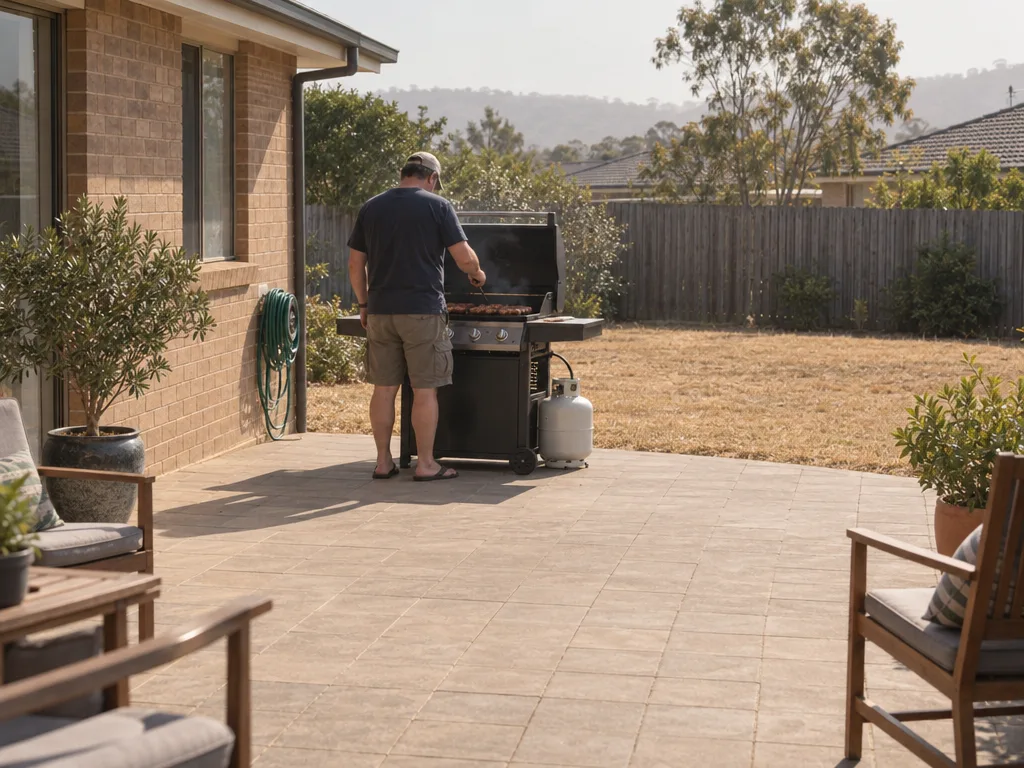
The barbecue rules come with conditions. An electric barbecue is allowed if an adult is present and nothing combustible is within 2 m. A gas barbecue is allowed on the same terms, plus water on hand and the barbecue within 20 m of a home. Solid-fuel barbecues and wood pizza ovens are not allowed.
If you hold a permit to burn, fire permits are suspended on Total Fire Ban days and may resume afterwards if they have not expired.
Can a roofer work on a total fire ban day?
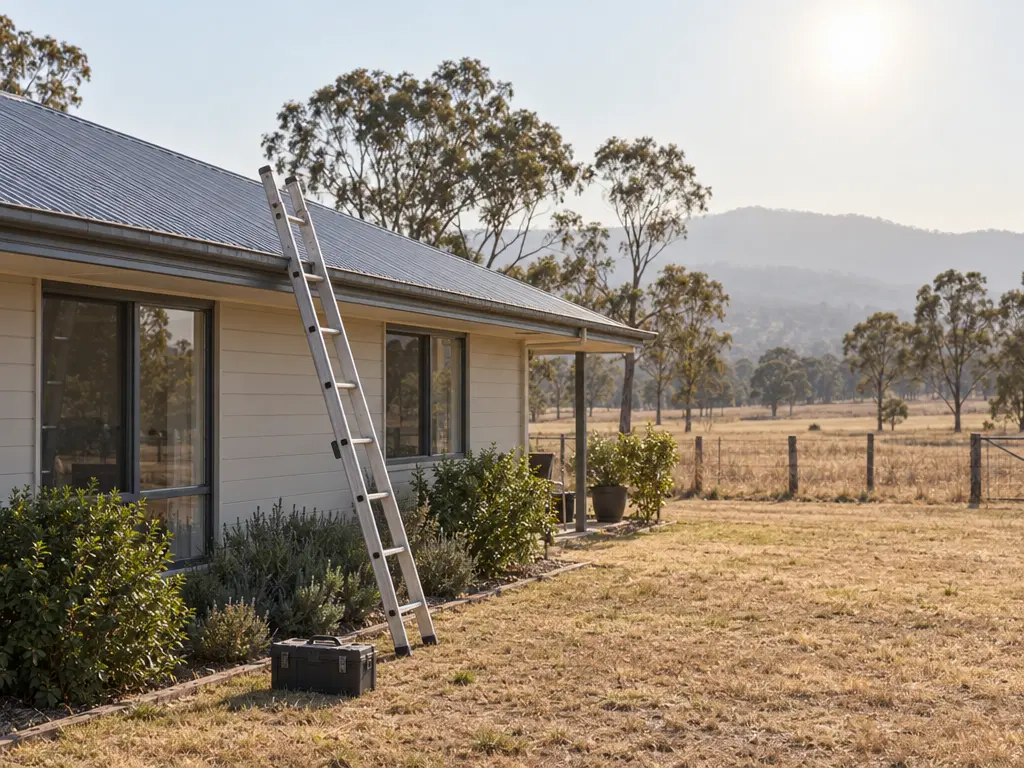
The RFS rules do not mention roofs, and they give no roof-specific ruling. The RFS rule is about hot works in the open.
Here is our reading, not the RFS's. Roof work happens outdoors. So roof tasks that throw a spark or a flame, such as angle-grinding roof sheets, gas torch work or soldering flashings, fall under that "in the open" rule.
That makes the useful question narrower than "is roofing allowed?" It is: "does my job need spark or flame work on that day?" Ask your tradesperson. If you are still unsure, the RFS is on 1800 679 737.
Do the exemptions cover roof work?
| Standard exemptions | Specific exemption | |
|---|---|---|
| Where it comes from | RFS Schedule of standard exemptions, applying only when that day's ban order names it, detailed in the NSW Government Gazette. | An application to the RFS when the standard exemptions don't cover the work. |
| Who decides | The RFS Commissioner. | The RFS Commissioner. |
| Lead time | Set by the day's order. | Minimum 21 days' processing. |
| Conditions | Building item: fire kept from escaping, adequate firefighting equipment on site, area below elevated work cleared of combustibles with fire prevented from falling to it, and the person in charge notifies the RFS Fire Control Centre or nearest Fire and Rescue NSW station and follows any direction. | An approval comes with conditions. |
| Neither column is a ruling on roof work. | ||
No source gives a roof-specific answer, so do not read any exemption as a green light for a roof job. The RFS keeps a schedule of standard exemptions. It includes urgent and essential building construction or demolition cutting, welding or grinding, plus some utility and emergency work.
That schedule is not a blanket permission: the RFS says "a standard exemption will not apply unless specifically referred to in the total fire ban order".
Where the building item does apply, it carries conditions. These are fire kept from escaping, adequate firefighting equipment on site, and the area below elevated work cleared of combustibles with fire prevented from falling to it. The person in charge must also notify the RFS Fire Control Centre, or the nearest Fire and Rescue NSW station, and follow any direction. Fire and Rescue NSW is on 1800 422 281.
Exemptions are decided by the RFS Commissioner and detailed in the NSW Government Gazette each time a ban is declared. If the standard list does not cover a piece of work, you can apply for a specific exemption. It needs a minimum of 21 days' processing, and an approval comes with conditions. For a job booked at short notice, that is no help.
What breaking a ban can cost
NSW Total Fire Ban penalties: maximum gaol terms (checked November 2026)
Lighting a fire on a ban day can also bring an on-the-spot fine.
Lighting a fire on a ban day, if it goes to court: up to 12 months' gaol and/or a fine
Fire that escapes and damages life, property or the environment: up to 14 years' gaol and/or much greater fines
Maximum gaol term, in years (0 to 14)
Civil suits for compensation are also possible.
Lighting a fire on a ban day can bring an on-the-spot fine, or a larger fine and/or up to 12 months' gaol if it goes to court (checked November 2026).
If a fire escapes and damages life, property or the environment, the penalty can reach much greater fines and/or up to 14 years' gaol (checked November 2026). Civil suits for compensation are also possible.
How to check if a ban is on
Ban-day planner for a roof job
Worked example: a job on Monday 14 December 2026, checked on Tuesday 1 December 2026
- Inside the statutory Bush Fire Danger Period (local dates may vary)
- Any Total Fire Ban for this day is decided the afternoon of Sunday 13 December 2026: check the RFS Fire Danger Ratings and Total Fire Bans page for Greater Hunter then, and the official rating on the morning of the job
- A specific exemption needs at least 21 days' processing: this job is 13 days away, fewer than the 21-day minimum
RFS Fire Danger Ratings and Total Fire Bans RFS 1800 679 737
Make it a routine on any day you have outdoor work planned between October and March.
- The afternoon before: open the RFS Fire Danger Ratings and Total Fire Bans page and look at Greater Hunter, which includes Singleton.
- On the day: check the official rating again, because forecast ratings are indicative only.
- Still unsure: call the RFS on 1800 679 737.
Two things are easy to mix up with a ban.
The first is the permit. During the Bush Fire Danger Period, Singleton is listed as requiring a permit to light a fire in the open. A permit does not help on a ban day, because permits are suspended then.
The second is the EPA's No-Burn Notice, which is a separate thing from a Total Fire Ban.
Get the roof ready before the ban days arrive
The season ahead looks hot. The Bureau of Meteorology's December to February outlook gives eastern NSW a greater than 70% chance of unusually high maximum temperatures.
The roof and gutter preparation itself is in our spring storms and fire danger check for Hunter Valley homes. If you are weighing up gutter screens, see leaf screeners in fire season.
The point here is timing. If roof work needs doing, a booking with room to move the date is simpler than squeezing it into a run of hot days.
Booking roof work in the fire season
When you book a roof job with Singleton Roofing between October and March, three questions are worth asking up front:
- Does any part of the job need spark or flame work outdoors, such as grinding, gas cutting or soldering?
- If a Total Fire Ban is declared for that day, is the plan to move the date, or is there a way to do that part without a spark or flame?
- Who checks the RFS page the afternoon before, you or the roofer?
To talk through a job and when it can be done, contact Singleton Roofing for a roofing quote.
Sources
- Total Fire Ban rules, NSW Rural Fire Service
- Schedule of standard exemptions to Total Fire Bans, NSW Rural Fire Service
- Fire Danger Ratings and Total Fire Bans, NSW Rural Fire Service
- Fire Danger Ratings, NSW Rural Fire Service
- Bush Fire Danger Period, NSW Rural Fire Service
- Can I have a barbecue during a fire ban?, ABC Emergency
- Total Fire Ban, Greater Hunter, ABC Emergency
- NSW weather: heatwave hits Greater Sydney, Hunter regions as total fire ban declared, The Nightly
- Climate outlooks, Bureau of Meteorology